
Exploring Alien Ecosystems: The Moons of Jupiter
March 25, 2026
Listen to this lesson:
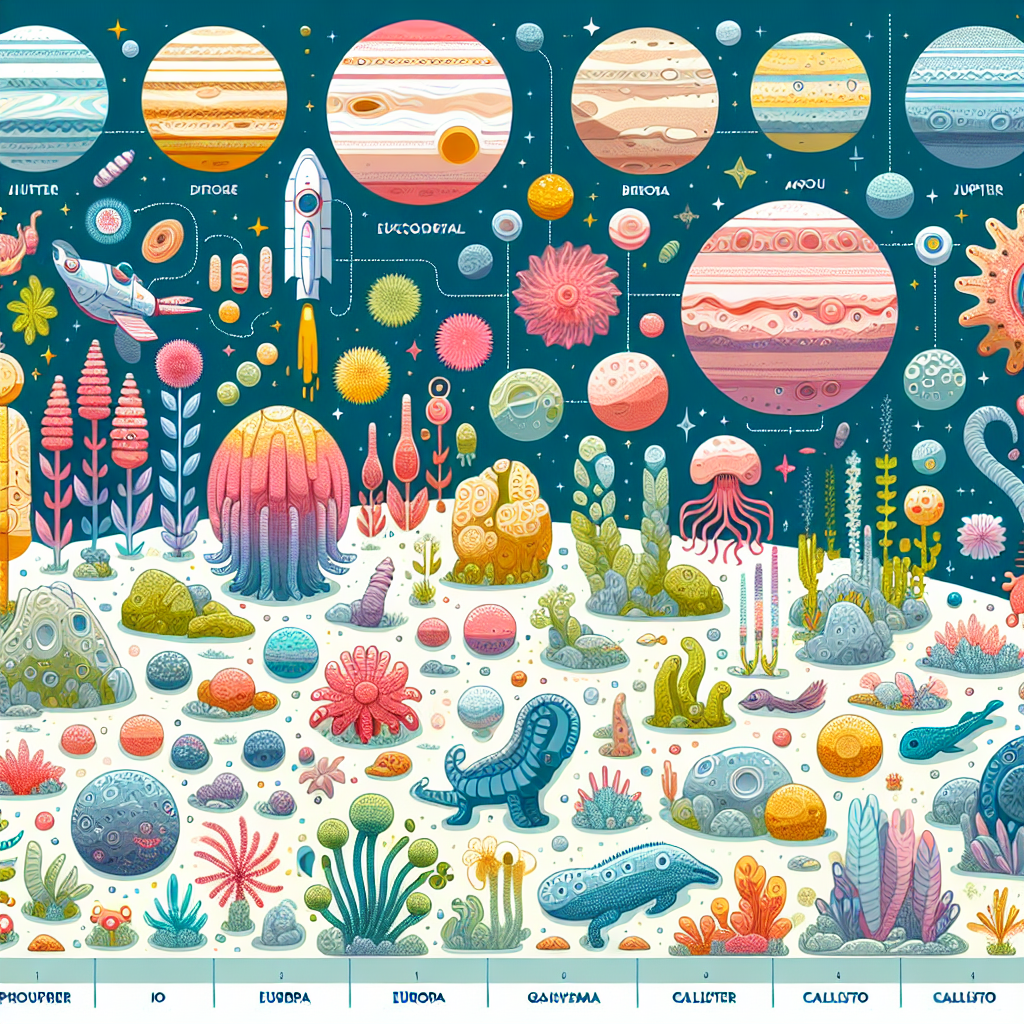
Imagine stepping onto a moon where the ground beneath your feet is a thick layer of ice and the sky above you is a swirling dance of colorful gases. Today, we'll journey to the fascinating moons orbiting Jupiter—places where scientists believe life might exist under icy surfaces. These moons, like Europa, Ganymede, and Callisto, are unique worlds with their own geological features and potential hidden oceans beneath the ice. By studying these celestial bodies, scientists hope to uncover secrets about the possibility of life beyond Earth.
Europa, with its smooth icy shell, is especially intriguing. Beneath its frozen crust, there might be a salty ocean, kept warm by the moon’s internal heat. This environment could be similar to Earth's deep ocean floors, where life thrives in darkness near hydrothermal vents. NASA's upcoming missions are set to investigate these icy moons, using robots to drill through the ice and explore the waters below, searching for signs of microbial life.
This exploration not only helps us understand our solar system better but also challenges our imagination about what life might look like beyond our planet. What adaptations might life forms need to survive in such extreme conditions? Could they be unlike anything we've seen on Earth? The potential discoveries on these moons could redefine our understanding of life itself.
Europa, with its smooth icy shell, is especially intriguing. Beneath its frozen crust, there might be a salty ocean, kept warm by the moon’s internal heat. This environment could be similar to Earth's deep ocean floors, where life thrives in darkness near hydrothermal vents. NASA's upcoming missions are set to investigate these icy moons, using robots to drill through the ice and explore the waters below, searching for signs of microbial life.
This exploration not only helps us understand our solar system better but also challenges our imagination about what life might look like beyond our planet. What adaptations might life forms need to survive in such extreme conditions? Could they be unlike anything we've seen on Earth? The potential discoveries on these moons could redefine our understanding of life itself.
Ask Your Kid: Ask Your Kid: If you were designing a robot to explore the icy oceans of Europa, what special features would it need to survive and make new discoveries?