
The Secret Lives of Comets
March 21, 2026
Listen to this lesson:
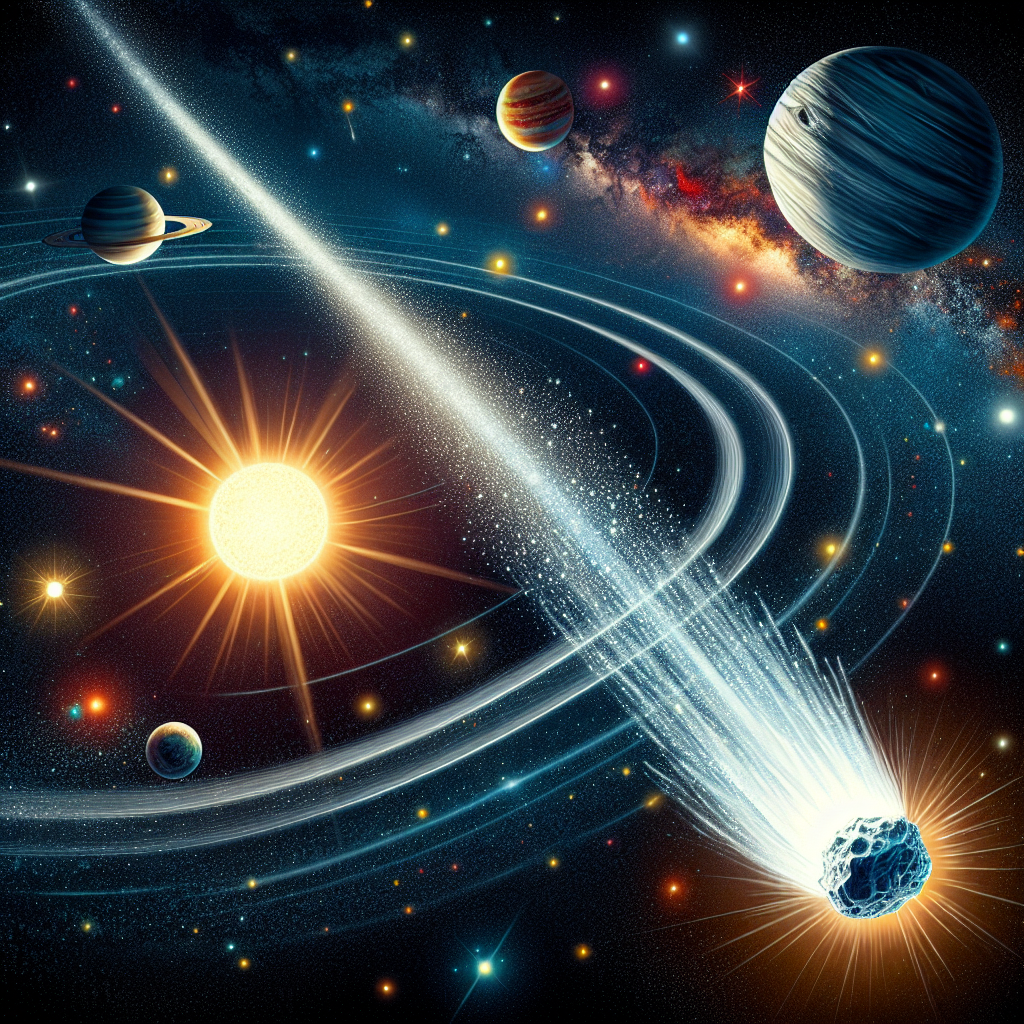
Comets are often called 'cosmic snowballs' because they are made up of ice, dust, and rocky material. These fascinating objects orbit the Sun in long, elliptical paths and become visible when they venture close to the Sun, where they heat up and develop glowing comas and tails. Unlike planets, which follow relatively circular orbits, comets have highly elongated paths that can take them far out into the solar system, sometimes beyond the orbit of Pluto.
As a comet nears the Sun, its ice begins to vaporize, releasing gas and dust. This process forms a bright, glowing head known as a coma, and often a spectacular tail that always points away from the Sun due to the solar wind. The tail can be millions of kilometers long, stretching across the sky. Every comet has a core, called a nucleus, which is the solid center and can vary in size from a few hundred meters to tens of kilometers across.
By studying comets, scientists gain insights into the early solar system since these celestial bodies are considered 'frozen time capsules' that hold clues about the ingredients and conditions present over 4 billion years ago. They offer a unique window into the past, helping us understand how the solar system formed and evolved.
As a comet nears the Sun, its ice begins to vaporize, releasing gas and dust. This process forms a bright, glowing head known as a coma, and often a spectacular tail that always points away from the Sun due to the solar wind. The tail can be millions of kilometers long, stretching across the sky. Every comet has a core, called a nucleus, which is the solid center and can vary in size from a few hundred meters to tens of kilometers across.
By studying comets, scientists gain insights into the early solar system since these celestial bodies are considered 'frozen time capsules' that hold clues about the ingredients and conditions present over 4 billion years ago. They offer a unique window into the past, helping us understand how the solar system formed and evolved.
Ask Your Kid: What do you think would happen if a comet came too close to the Earth?