
Journey to the Hidden World of Exoplanets
February 20, 2026
Listen to this lesson:
Let's embark on a cosmic adventure to explore exoplanets—a fascinating type of planet that orbits stars outside our own solar system. Unlike the familiar planets you know like Earth or Mars, exoplanets can be quite mysterious and diverse. Some are scorching gas giants, others are icy worlds, and a few might even resemble Earth with rocky surfaces and oceans. Astronomers use telescopes to detect these distant planets by observing the dimming of starlight as the planets pass in front of their stars, a method known as the transit technique. This groundbreaking strategy has led to the discovery of thousands of exoplanets, each with its own unique characteristics.
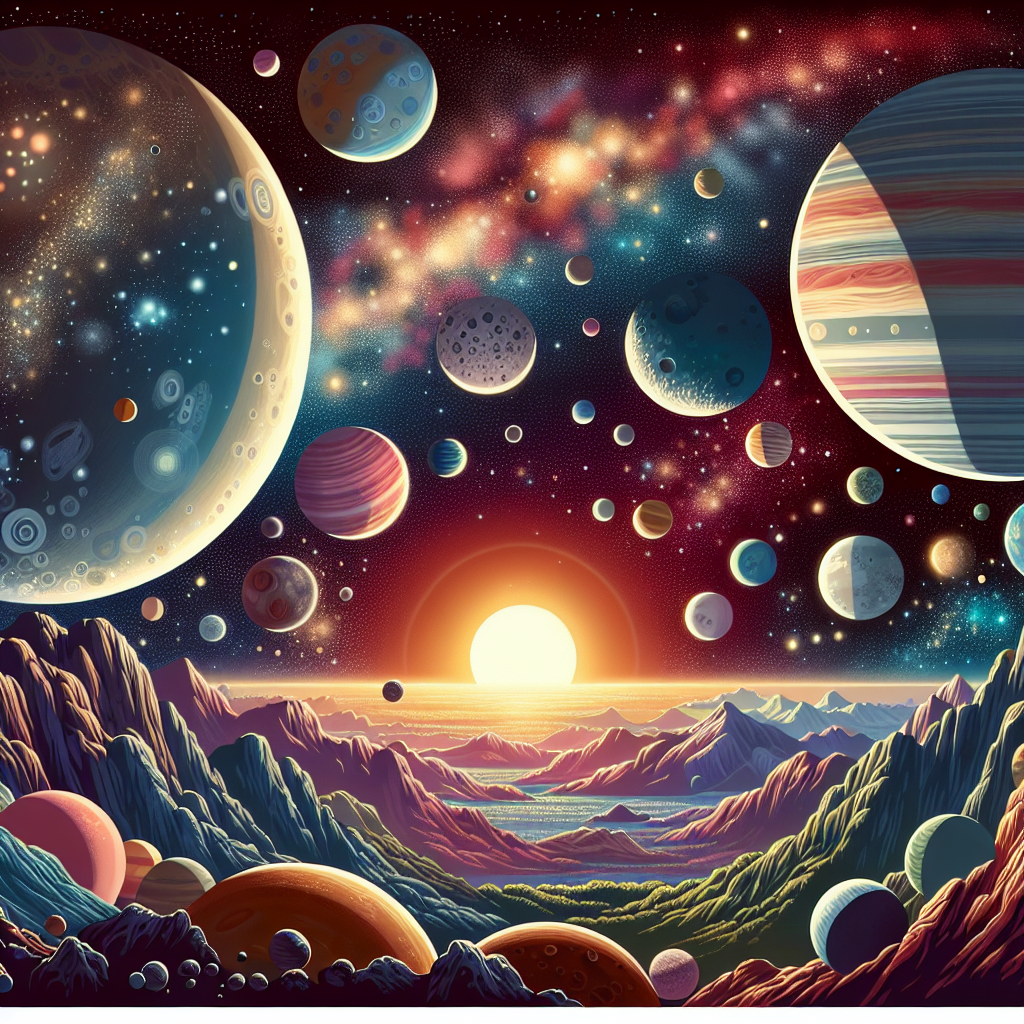
Imagine standing on an exoplanet: the sky might have multiple suns or even a strange color due to its atmosphere. Scientists are particularly excited about finding exoplanets within the 'habitable zone'—the perfect distance from a star where conditions might be right for life as we know it. This is where water could exist in liquid form, a key ingredient for life. Discovering an Earth-like exoplanet in this zone sparks questions about whether we are alone in the universe or if other life forms are also gazing up at their stars.
In our quest to understand these alien worlds, space telescopes like the James Webb Space Telescope are crucial. They help us learn more about exoplanets' atmospheres and potential to support life. Each discovery brings us closer to answering one of humanity's oldest questions: Is there life beyond Earth? Scientists continue to study these distant worlds, hoping to uncover their secrets and perhaps, in the future, find an exoplanet that feels a little like home.
Imagine standing on an exoplanet: the sky might have multiple suns or even a strange color due to its atmosphere. Scientists are particularly excited about finding exoplanets within the 'habitable zone'—the perfect distance from a star where conditions might be right for life as we know it. This is where water could exist in liquid form, a key ingredient for life. Discovering an Earth-like exoplanet in this zone sparks questions about whether we are alone in the universe or if other life forms are also gazing up at their stars.
In our quest to understand these alien worlds, space telescopes like the James Webb Space Telescope are crucial. They help us learn more about exoplanets' atmospheres and potential to support life. Each discovery brings us closer to answering one of humanity's oldest questions: Is there life beyond Earth? Scientists continue to study these distant worlds, hoping to uncover their secrets and perhaps, in the future, find an exoplanet that feels a little like home.
Ask Your Kid: Ask Your Kid: If you could design an exoplanet, what would it look like and what kind of creatures might live there?