Journey to the Cosmic Dances of the Planets
February 17, 2026
Listen to this lesson:
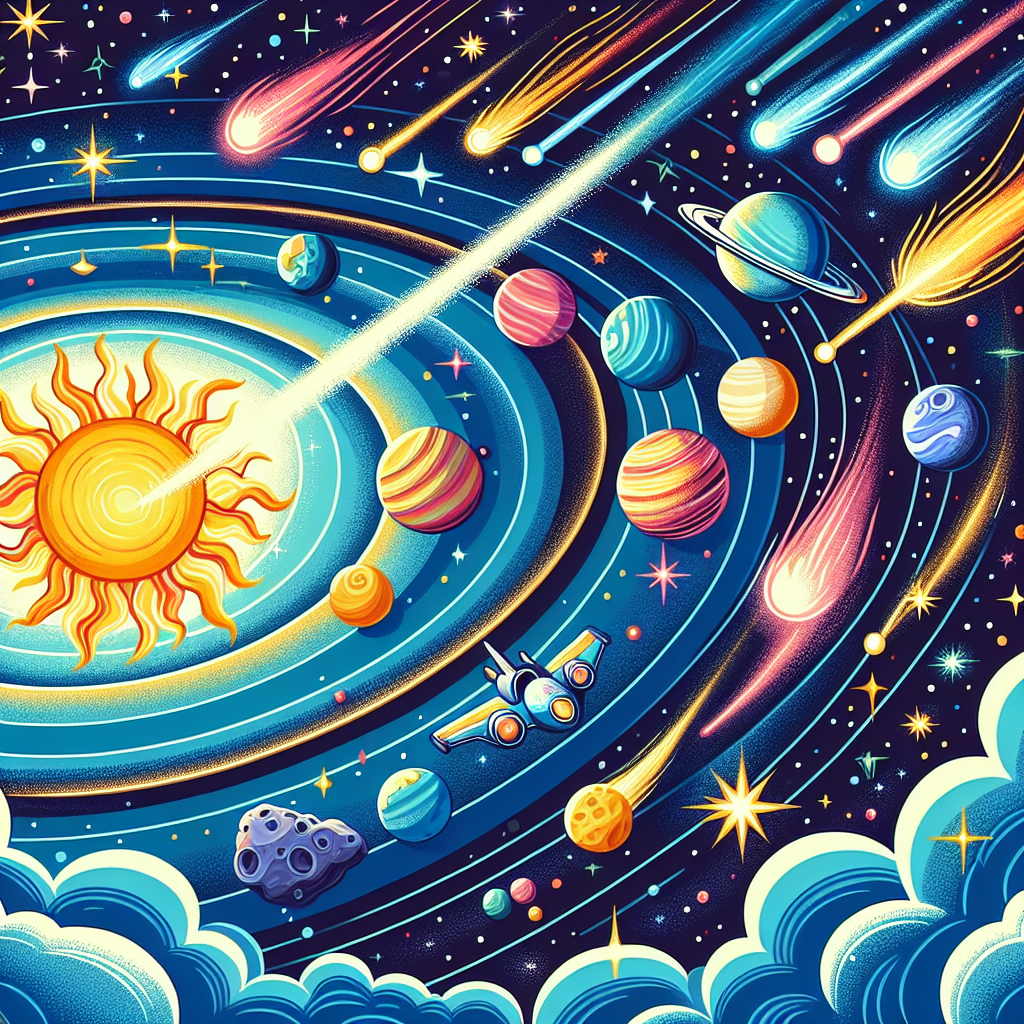
Imagine a grand ballroom in space where planets dance in an elaborate cosmic waltz around our Sun! Each planet, from the tiny Mercury to the gigantic Jupiter, has its unique orbit, forming a celestial choreography that has fascinated humans for centuries. These orbits are not just circles, but more like stretched-out circles called ellipses. The speed at which each planet travels is also different, adding a rhythm to the solar system's galactic dance floor.
The planets are not just spinning around the Sun; they are also spinning on their own axes. This rotation is what creates day and night. For example, Earth takes about 24 hours to complete one spin, which is why we have day and night every 24 hours. Some planets, like Venus, spin very slowly, while others, like Jupiter, spin at an incredible speed! Understanding these spins and orbits helps us learn about the length of a day or a year on different planets.
Each planet's dance is influenced by its gravitational pull, which keeps them in their paths. If gravity didn't exist, planets would float away into space, and we'd lose our sunny days and starry nights. Learning about these gravitational forces helps us appreciate the delicate balance that keeps our solar system in harmony. The next time you look up at the night sky, imagine the planets going about their cosmic dance, each step an integral part of the universe's grand performance.
The planets are not just spinning around the Sun; they are also spinning on their own axes. This rotation is what creates day and night. For example, Earth takes about 24 hours to complete one spin, which is why we have day and night every 24 hours. Some planets, like Venus, spin very slowly, while others, like Jupiter, spin at an incredible speed! Understanding these spins and orbits helps us learn about the length of a day or a year on different planets.
Each planet's dance is influenced by its gravitational pull, which keeps them in their paths. If gravity didn't exist, planets would float away into space, and we'd lose our sunny days and starry nights. Learning about these gravitational forces helps us appreciate the delicate balance that keeps our solar system in harmony. The next time you look up at the night sky, imagine the planets going about their cosmic dance, each step an integral part of the universe's grand performance.
Ask Your Kid: Ask Your Kid: If you could be a planet, which one would you choose and why? How would you dance in the solar system?