Exploring the Whispering Moons of Jupiter
February 14, 2026
Listen to this lesson:
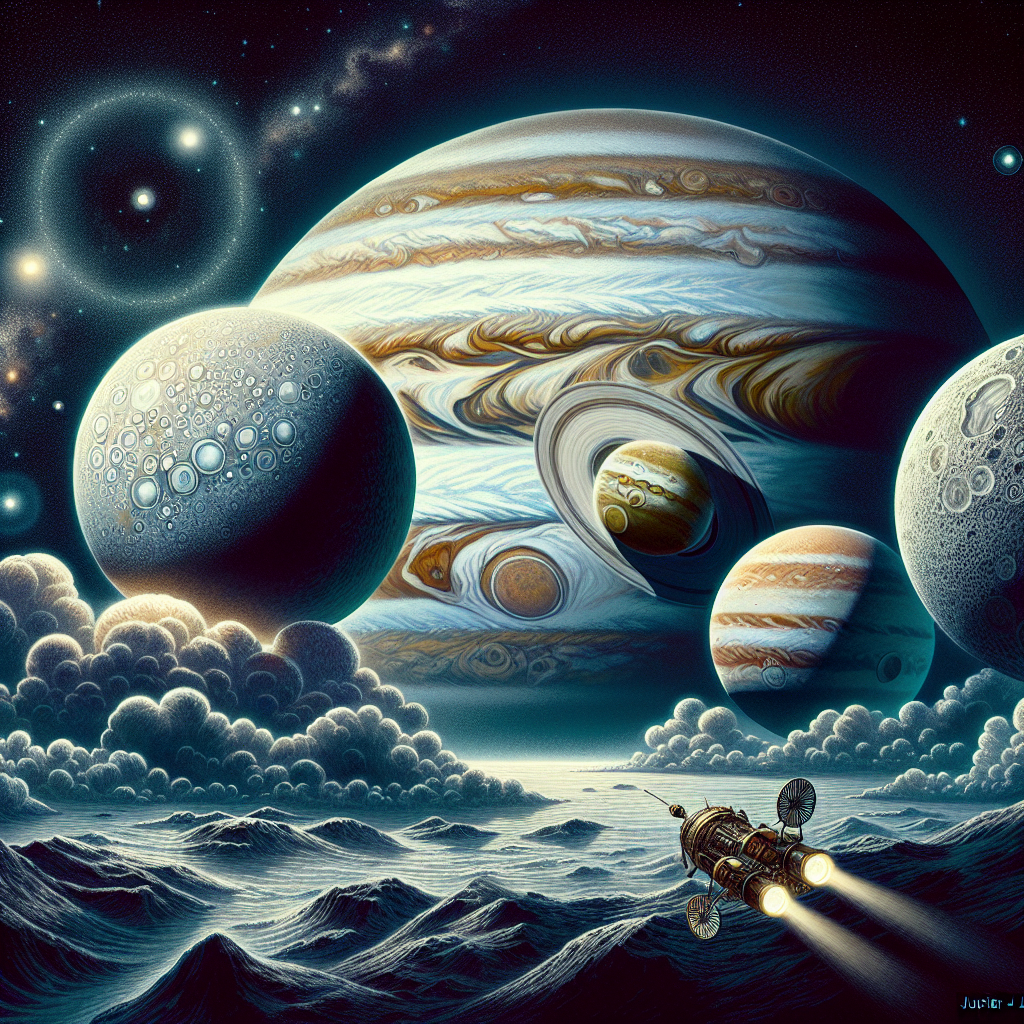
Imagine peering through a telescope and discovering a world brimming with mysteries. Today, we'll embark on an exploration of Jupiter's intriguing moons. Jupiter, the largest planet in our solar system, is accompanied by a multitude of moons that orbit it, each one unique in its own way. Among them, the four largest—Io, Europa, Ganymede, and Callisto—are known as the Galilean moons, named after the astronomer Galileo Galilei who first observed them in 1610. These moons are not just celestial bodies; they are worlds with fascinating features. Io is the most volcanically active body in our solar system, Europa's icy surface hides an ocean beneath, Ganymede is the largest moon, even bigger than Mercury, and Callisto is the most heavily cratered object we know.
Imagine these moons whispering tales of volcanoes, hidden oceans, and ancient impacts as they spin around their giant host. Scientists use spacecraft like the Juno probe to gather information about these moons, hoping to uncover secrets that could tell us more about the potential for life beyond Earth. The icy crust of Europa, for instance, sparks curiosity about its subsurface ocean, which may harbor conditions suitable for life. These celestial neighbors of ours invite us to dream about the possibilities of alien ecosystems and the wonders of space.
As you ponder these distant worlds, think about what it would be like to visit them. How would it feel to stand on Io's fiery surface or glide beneath Europa's icy shell? Our understanding of these moons continues to grow with each passing mission, painting a picture of a dynamic and diverse solar system. So, let's continue to wonder and question, for the universe still holds many secrets waiting to be discovered.
Imagine these moons whispering tales of volcanoes, hidden oceans, and ancient impacts as they spin around their giant host. Scientists use spacecraft like the Juno probe to gather information about these moons, hoping to uncover secrets that could tell us more about the potential for life beyond Earth. The icy crust of Europa, for instance, sparks curiosity about its subsurface ocean, which may harbor conditions suitable for life. These celestial neighbors of ours invite us to dream about the possibilities of alien ecosystems and the wonders of space.
As you ponder these distant worlds, think about what it would be like to visit them. How would it feel to stand on Io's fiery surface or glide beneath Europa's icy shell? Our understanding of these moons continues to grow with each passing mission, painting a picture of a dynamic and diverse solar system. So, let's continue to wonder and question, for the universe still holds many secrets waiting to be discovered.
Ask Your Kid: If you could send a spacecraft to one of Jupiter’s moons, which one would you choose and why?