
The Mysterious Moons of Jupiter
February 10, 2026
Listen to this lesson:
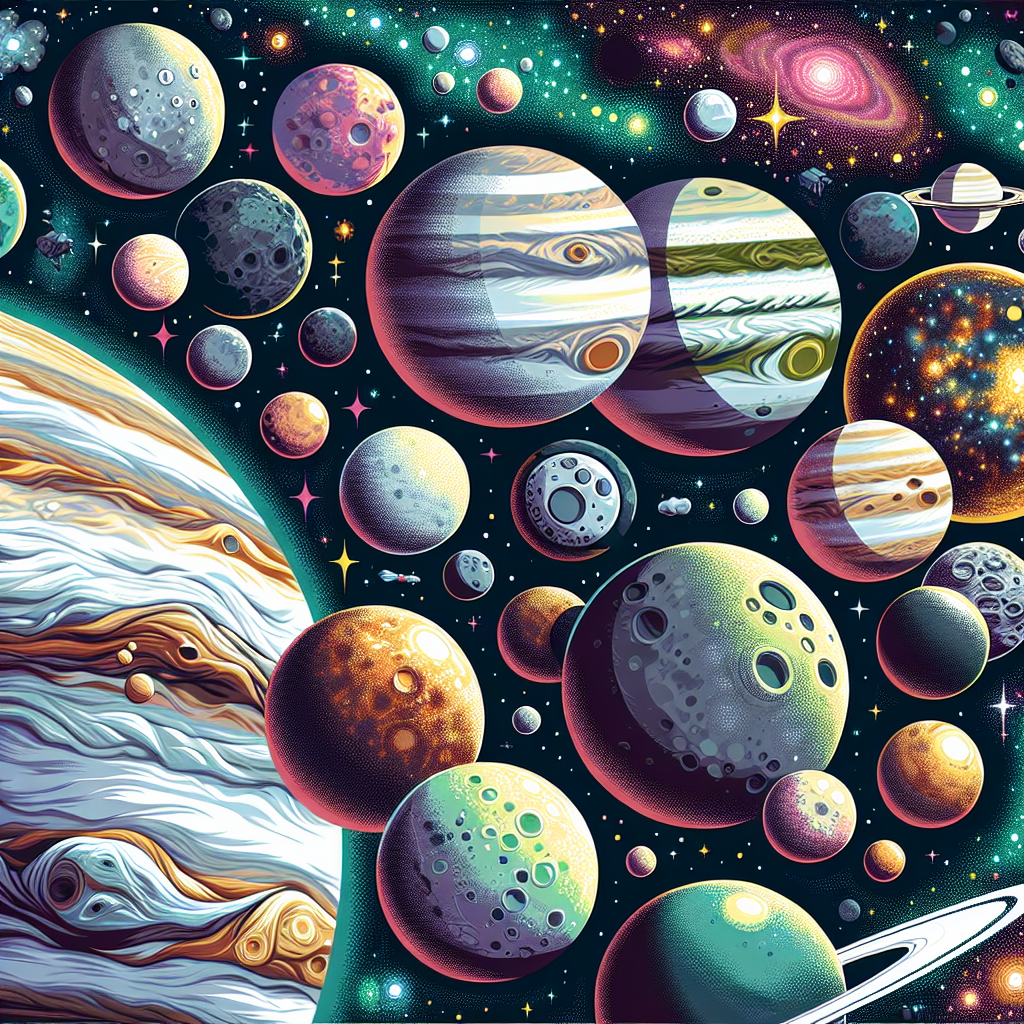
Jupiter, the largest planet in our solar system, is not only famous for its size but also for its many moons. With over 79 moons, each one is unique and has its own story to tell. Some of these moons, like Ganymede, are larger than the planet Mercury! Ganymede is particularly interesting because it has its own magnetic field, something no other moon in our solar system possesses. This magnetic field creates auroras, similar to the Northern Lights on Earth, painting a colorful spectacle in its thin atmosphere.
One of the most intriguing moons is Europa, a frozen world that scientists believe hides an ocean beneath its icy surface. This ocean might be a place where life could exist. Imagine creatures living in a vast, dark sea, warmed by the heat from the moon's core! Scientists are eager to explore Europa further, hoping to discover if life beyond Earth could thrive in such an alien environment.
Meanwhile, Io, another of Jupiter’s moons, is the most volcanically active body in the solar system. Its surface is dotted with hundreds of volcanoes that constantly spew lava and sulfurous gases. These volcanic eruptions are so powerful that they can be seen from space! Io's vibrant colors and extreme activity make it a fascinating place for astronomers and a vivid reminder of how diverse and dynamic our universe can be.
One of the most intriguing moons is Europa, a frozen world that scientists believe hides an ocean beneath its icy surface. This ocean might be a place where life could exist. Imagine creatures living in a vast, dark sea, warmed by the heat from the moon's core! Scientists are eager to explore Europa further, hoping to discover if life beyond Earth could thrive in such an alien environment.
Meanwhile, Io, another of Jupiter’s moons, is the most volcanically active body in the solar system. Its surface is dotted with hundreds of volcanoes that constantly spew lava and sulfurous gases. These volcanic eruptions are so powerful that they can be seen from space! Io's vibrant colors and extreme activity make it a fascinating place for astronomers and a vivid reminder of how diverse and dynamic our universe can be.
Ask Your Kid: Ask Your Kid: If you could visit one of Jupiter's moons, which one would you choose and why?