Dancing Shadows: The Art of Solar Eclipses
January 24, 2026
Listen to this lesson:
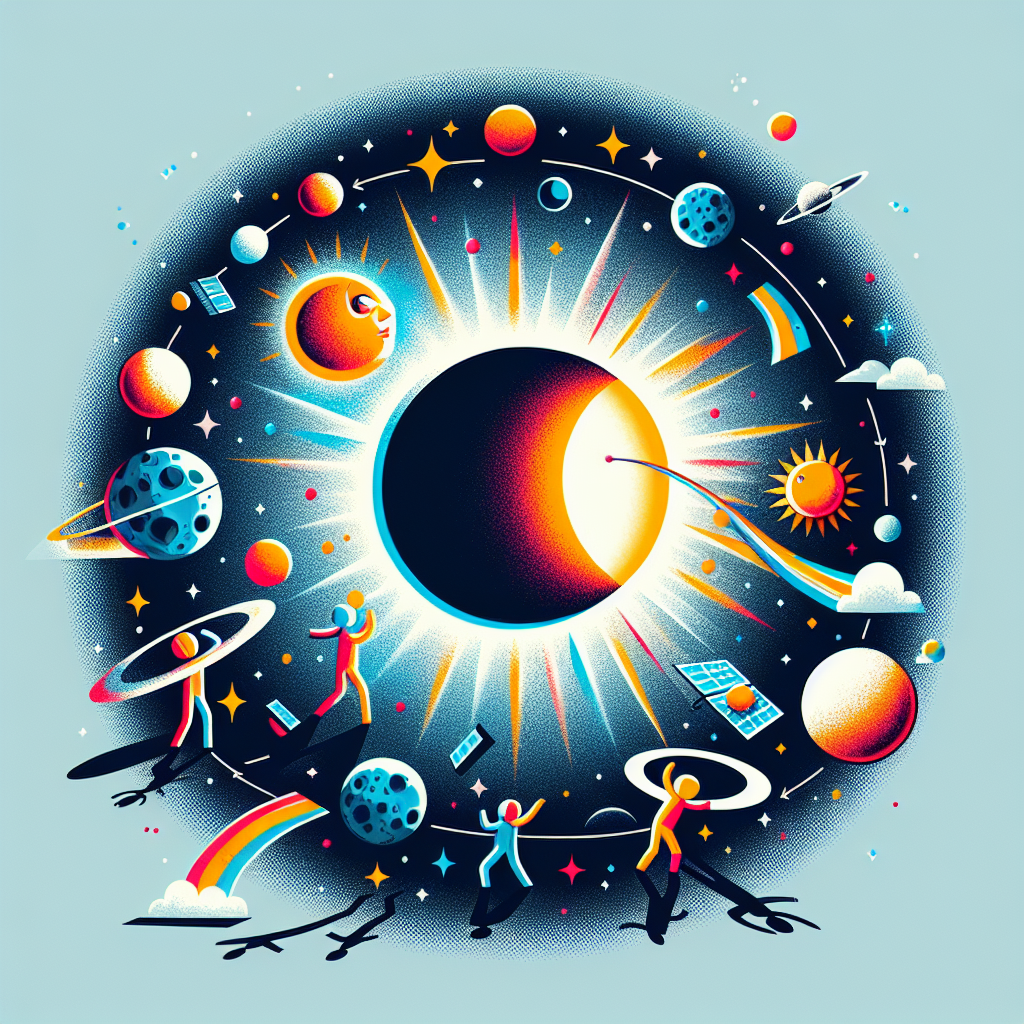
Imagine the sun, moon, and Earth playing a cosmic game of hide and seek. A solar eclipse occurs when the moon moves between the Earth and the sun, casting a shadow on our planet. This celestial event offers a mesmerizing spectacle, as daytime briefly turns to twilight and the sky is painted with hues of gold and silver. During a total solar eclipse, the sun's bright face is completely obscured by the moon, revealing the sun's outer atmosphere, known as the corona. It's a rare moment where the mighty sun takes backstage, allowing the moon to showcase its shadowy dance.
The path where the total eclipse is visible is called the path of totality, and it is often less than 100 miles wide. Outside this path, observers can see a partial eclipse, where only part of the sun is obscured. These events have fascinated humans for centuries, inspiring myths and legends across cultures. Ancient civilizations often saw eclipses as powerful omens, while today, they provide valuable opportunities for scientists to study the sun's atmosphere and the effects of solar phenomena on Earth.
The next time you have a chance to witness an eclipse, remember to use special glasses to protect your eyes. Have you ever thought about how many times such a perfect alignment must occur for us to see this natural wonder? It's one of the universe's many magical performances, orchestrated with precision and grace.
The path where the total eclipse is visible is called the path of totality, and it is often less than 100 miles wide. Outside this path, observers can see a partial eclipse, where only part of the sun is obscured. These events have fascinated humans for centuries, inspiring myths and legends across cultures. Ancient civilizations often saw eclipses as powerful omens, while today, they provide valuable opportunities for scientists to study the sun's atmosphere and the effects of solar phenomena on Earth.
The next time you have a chance to witness an eclipse, remember to use special glasses to protect your eyes. Have you ever thought about how many times such a perfect alignment must occur for us to see this natural wonder? It's one of the universe's many magical performances, orchestrated with precision and grace.
Ask Your Kid: Ask Your Kid: What do you think it would feel like to stand in the path of totality during a solar eclipse?