Cosmic Choreography: The Dance of Distant Planets
January 20, 2026
Listen to this lesson:
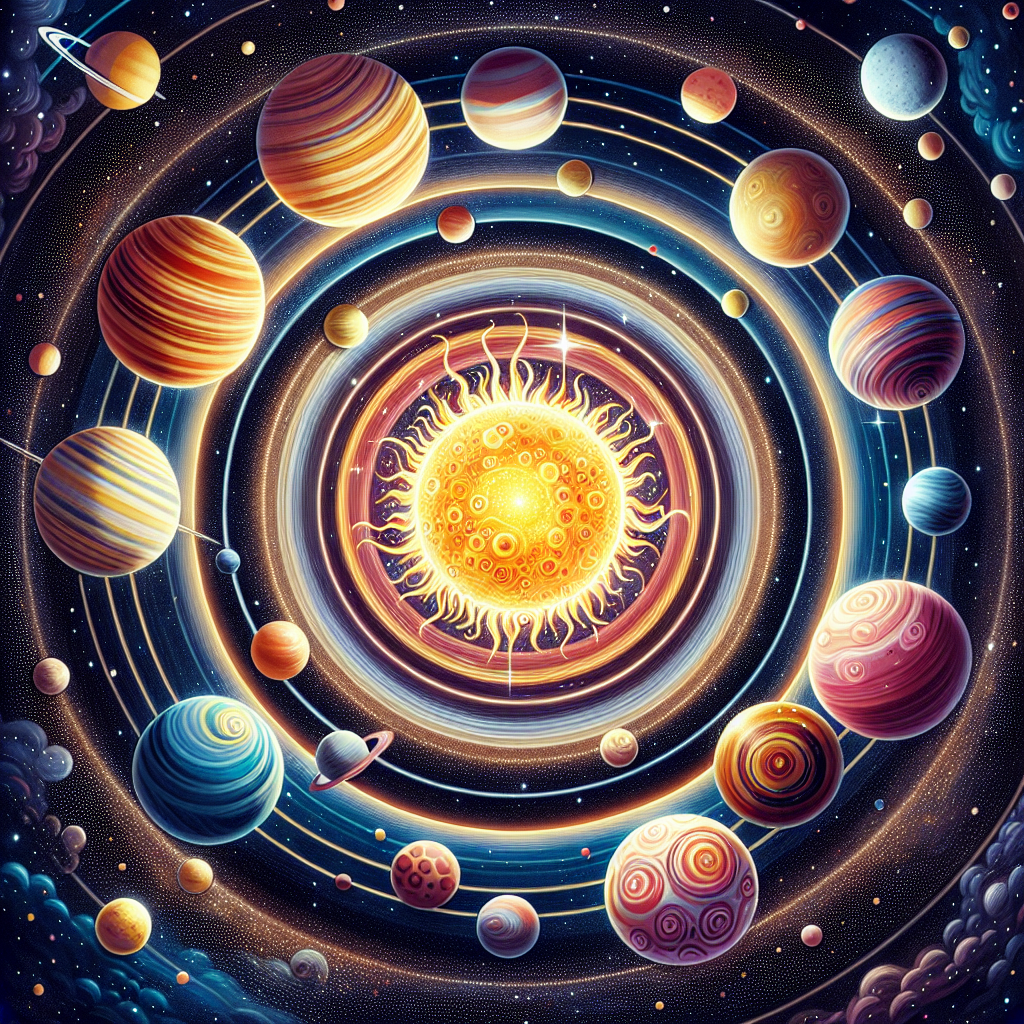
Imagine a grand ballroom in space where planets waltz around their stars, each with its unique rhythm and path. This cosmic dance is not just a spectacle but a complex interplay governed by gravity. Every planet, from the smallest rocky ones to the largest gas giants, follows a specific orbit. These orbits can be circular, like a race track, or more elliptical, like an elongated oval. The Sun's gravity acts like an invisible hand, guiding the planets along their paths, ensuring they don’t stray away into the vastness of space.
Now, let's delve into the magic of exoplanets—worlds that orbit stars beyond our Sun. These distant planets can be incredibly different from what we know in our solar system. Some may be scorching hot, orbiting very close to their stars, while others might be icy and far away. Scientists use advanced telescopes to study them, trying to understand the possibility of life in these remote places. Exploring exoplanets helps us learn more about the universe and our place within it.
As planets and stars perform their age-old dance, we also discover fascinating phenomena like planetary rings, moon migrations, and even star systems with more than one sun! These celestial wonders remind us of the vastness and diversity of the cosmos, sparking our imagination and curiosity about the mysteries that lie beyond our sight.
Now, let's delve into the magic of exoplanets—worlds that orbit stars beyond our Sun. These distant planets can be incredibly different from what we know in our solar system. Some may be scorching hot, orbiting very close to their stars, while others might be icy and far away. Scientists use advanced telescopes to study them, trying to understand the possibility of life in these remote places. Exploring exoplanets helps us learn more about the universe and our place within it.
As planets and stars perform their age-old dance, we also discover fascinating phenomena like planetary rings, moon migrations, and even star systems with more than one sun! These celestial wonders remind us of the vastness and diversity of the cosmos, sparking our imagination and curiosity about the mysteries that lie beyond our sight.
Ask Your Kid: Ask Your Kid: If you could design your own planet, what kind of dance would it do around its star, and what would make it unique?