
Dancing with the Stars: The Journey of Light
December 30, 2025
Listen to this lesson:
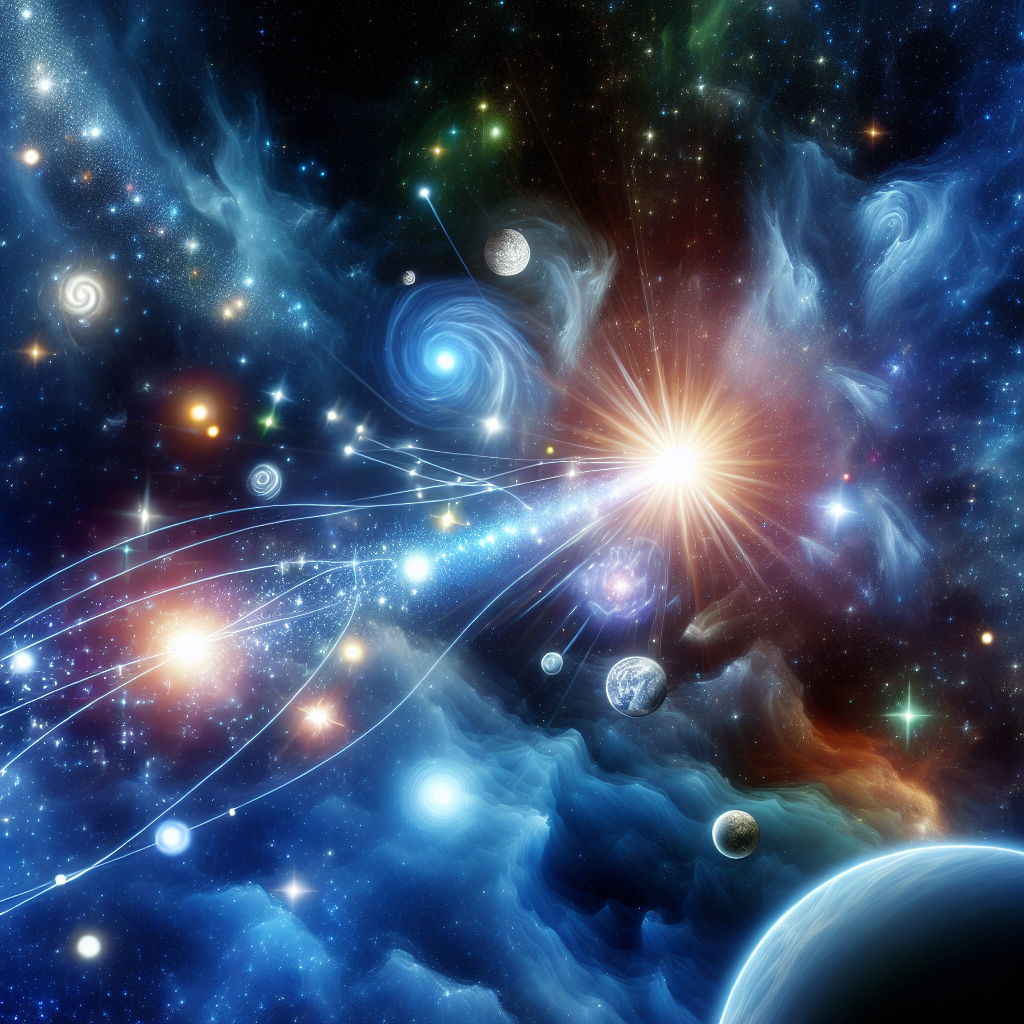
Imagine you're an astronaut floating in space, surrounded by a vast expanse of twinkling lights. These aren't just stars, they're cosmic beacons sending out streams of light across the universe. But what happens to this light as it travels through the cosmos? Today, we're going to explore the fascinating journey of light and how it creates the beautiful sky we see from Earth.
Light travels incredibly fast, about 186,000 miles per second! As it zooms through space, it sometimes encounters obstacles like dust clouds or galaxies, which can scatter or bend it. This bending of light is called 'gravitational lensing,' and it can create stunning visual effects like rings and arcs in the sky. These cosmic spectacles allow astronomers to learn more about the universe's structure and even discover hidden celestial bodies.
Let's also think about the colors of light. When light passes through different mediums or gets split by prisms, it reveals a spectrum of colors. This is why rainbows appear after a storm, as sunlight is refracted by raindrops in the atmosphere. Each color has its unique wavelength, and by studying these, scientists can determine what stars are made of, or even if faraway planets might have signs of life.
Light travels incredibly fast, about 186,000 miles per second! As it zooms through space, it sometimes encounters obstacles like dust clouds or galaxies, which can scatter or bend it. This bending of light is called 'gravitational lensing,' and it can create stunning visual effects like rings and arcs in the sky. These cosmic spectacles allow astronomers to learn more about the universe's structure and even discover hidden celestial bodies.
Let's also think about the colors of light. When light passes through different mediums or gets split by prisms, it reveals a spectrum of colors. This is why rainbows appear after a storm, as sunlight is refracted by raindrops in the atmosphere. Each color has its unique wavelength, and by studying these, scientists can determine what stars are made of, or even if faraway planets might have signs of life.
Ask Your Kid: Ask Your Kid: If you could catch a beam of light and travel with it, where in the universe would you like to go and why?