The Secret Dance of Asteroids
December 29, 2025
Listen to this lesson:
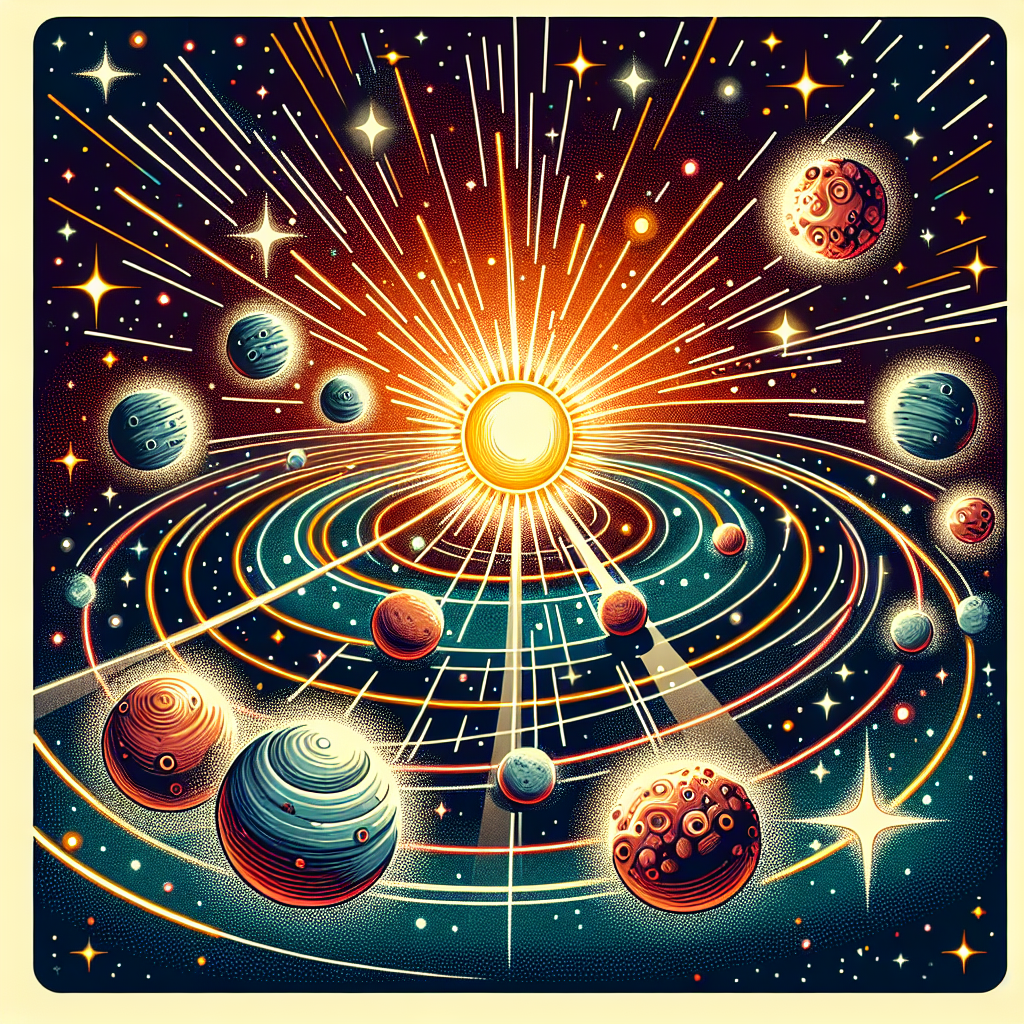
In the vastness of our solar system, a fascinating ballet is taking place far from our view. This performance involves thousands of rocky bodies called asteroids, which orbit the Sun mainly in a region between Mars and Jupiter known as the Asteroid Belt. These space rocks come in all shapes and sizes, some as small as a pebble, while others are hundreds of miles wide. But what makes their dance extraordinary is how they manage to keep moving in their paths without colliding with each other most of the time!
Scientists believe that asteroids are leftover building blocks from the formation of our solar system, giving us clues about how planets, including Earth, came to be. Imagine these rocks as pieces of a giant puzzle that never quite fit together. Occasionally, gravity from nearby planets or other forces can nudge an asteroid out of its usual path, sending it on a journey that can take it closer to Earth or even beyond the asteroid belt.
Asteroids also play a critical role in our planet's history. It is widely accepted that a massive asteroid impact led to the extinction of the dinosaurs around 65 million years ago. This event paved the way for mammals to become the dominant species on Earth. Understanding asteroids helps us learn about Earth's past and prepare for the future, as scientists work on ways to prevent potential asteroid impacts. So, these humble space rocks are more than just floating debris; they are storytellers of the universe.
Scientists believe that asteroids are leftover building blocks from the formation of our solar system, giving us clues about how planets, including Earth, came to be. Imagine these rocks as pieces of a giant puzzle that never quite fit together. Occasionally, gravity from nearby planets or other forces can nudge an asteroid out of its usual path, sending it on a journey that can take it closer to Earth or even beyond the asteroid belt.
Asteroids also play a critical role in our planet's history. It is widely accepted that a massive asteroid impact led to the extinction of the dinosaurs around 65 million years ago. This event paved the way for mammals to become the dominant species on Earth. Understanding asteroids helps us learn about Earth's past and prepare for the future, as scientists work on ways to prevent potential asteroid impacts. So, these humble space rocks are more than just floating debris; they are storytellers of the universe.
Ask Your Kid: Ask Your Kid: If you could send a spacecraft to study an asteroid up close, what would you want to discover about it and why?