The Cosmic Dance of Moons
December 23, 2025
Listen to this lesson:
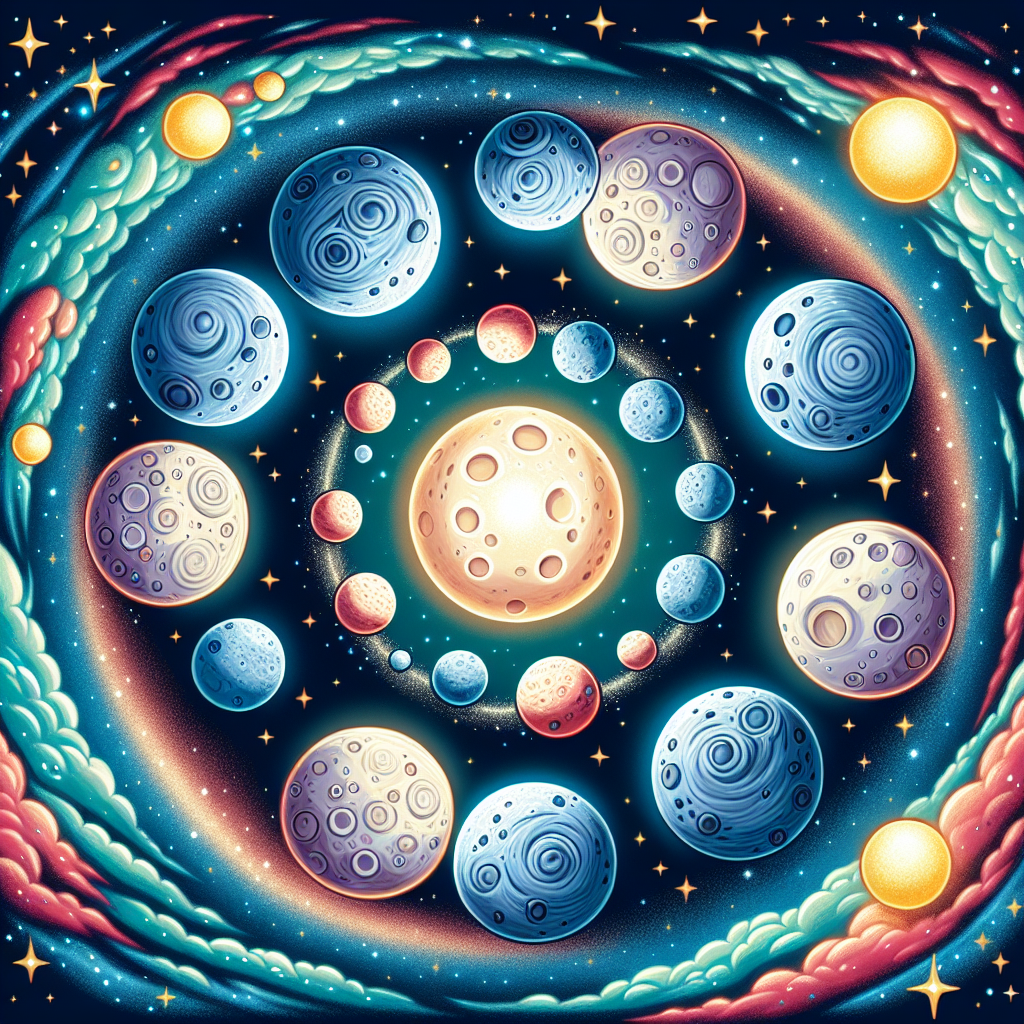
Imagine a grand ballet happening in the sky, where moons perform a celestial dance around their planets. These moons, also known as natural satellites, come in all shapes and sizes, each with unique characteristics. Some moons, like Jupiter's Ganymede, are icy and larger than the planet Mercury, while others, like Mars' Phobos, are small, rocky, and irregularly shaped. Each moon has its own orbit, and they move around their planets in a rhythm set by gravity, creating a cosmic dance that has lasted for billions of years.
Not all moons are the same, though. For example, Saturn's moon Titan has a thick atmosphere and lakes filled with liquid methane, while our Moon is dry and barren. Moons can have volcanoes, geysers, or even underground oceans. Scientists study these moons to learn more about the conditions that might allow life to exist elsewhere in the universe. By examining the diverse features and behaviors of moons, we gain a deeper understanding of the dynamic and ever-changing nature of our solar system.
The next time you look up at the night sky, think about the moons orbiting the planets beyond our view. They might seem distant, but they are part of the same cosmic family as Earth. Each moon holds secrets waiting to be uncovered, offering clues about the history and future of the universe.
Not all moons are the same, though. For example, Saturn's moon Titan has a thick atmosphere and lakes filled with liquid methane, while our Moon is dry and barren. Moons can have volcanoes, geysers, or even underground oceans. Scientists study these moons to learn more about the conditions that might allow life to exist elsewhere in the universe. By examining the diverse features and behaviors of moons, we gain a deeper understanding of the dynamic and ever-changing nature of our solar system.
The next time you look up at the night sky, think about the moons orbiting the planets beyond our view. They might seem distant, but they are part of the same cosmic family as Earth. Each moon holds secrets waiting to be uncovered, offering clues about the history and future of the universe.
Ask Your Kid: Ask Your Kid: If you could visit any moon in our solar system, which one would you choose and why?