
The Dance of the Planets
December 22, 2025
Listen to this lesson:
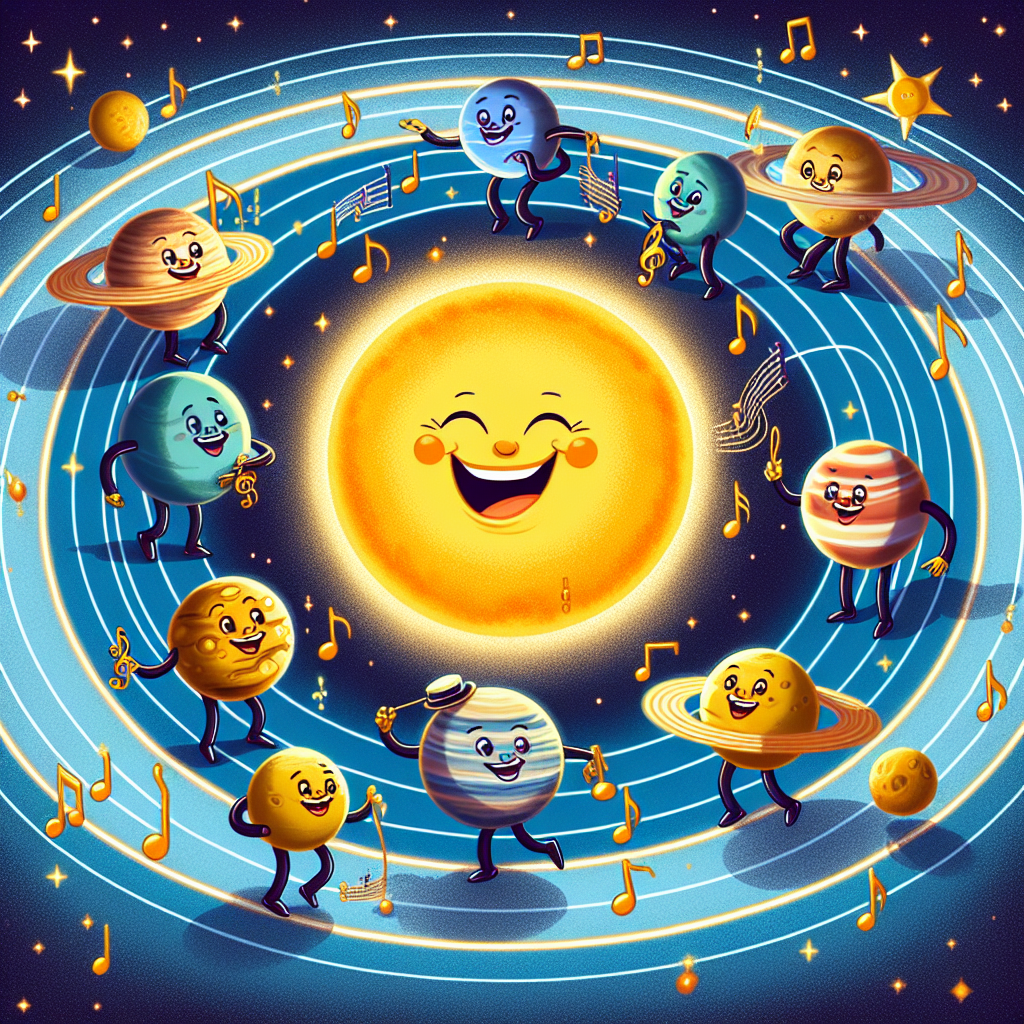
Imagine the planets in our solar system as graceful dancers, each with their unique steps and rhythms as they move around the Sun. This dance is called an orbit, and it takes each planet on a unique journey through space. Earth, for example, takes 365 days to complete one turn around the Sun, while Mercury, the speedy dancer, zips around in just 88 days! Each planet's orbit is like a fingerprint, special and distinctive, shaped by its distance from the Sun and its speed.
Now, let's think about how these orbits create patterns in the sky. Just like when dancers twirl across a stage, sometimes planets appear to move backward in the sky in an optical illusion called retrograde motion. This happens because of the different speeds and paths of the planets as they orbit the Sun. It's like when you're on a faster ride at the amusement park and you pass a slower one, making it look like the slower ride is moving backward.
Through this cosmic dance, we can learn about the history and future of our solar system. Scientists use special tools to track these movements, helping us understand planetary alignments and even predict eclipses and meteor showers. It's amazing to think how these celestial performers have been dancing for billions of years, creating a ballet that's both ancient and ongoing.
Now, let's think about how these orbits create patterns in the sky. Just like when dancers twirl across a stage, sometimes planets appear to move backward in the sky in an optical illusion called retrograde motion. This happens because of the different speeds and paths of the planets as they orbit the Sun. It's like when you're on a faster ride at the amusement park and you pass a slower one, making it look like the slower ride is moving backward.
Through this cosmic dance, we can learn about the history and future of our solar system. Scientists use special tools to track these movements, helping us understand planetary alignments and even predict eclipses and meteor showers. It's amazing to think how these celestial performers have been dancing for billions of years, creating a ballet that's both ancient and ongoing.
Ask Your Kid: Ask Your Kid: If you could create a new dance move inspired by a planet's orbit, what would it look like and which planet would you choose?