Mysteries of the Cosmic Ocean: Exploring Space Waves
December 19, 2025
Listen to this lesson:
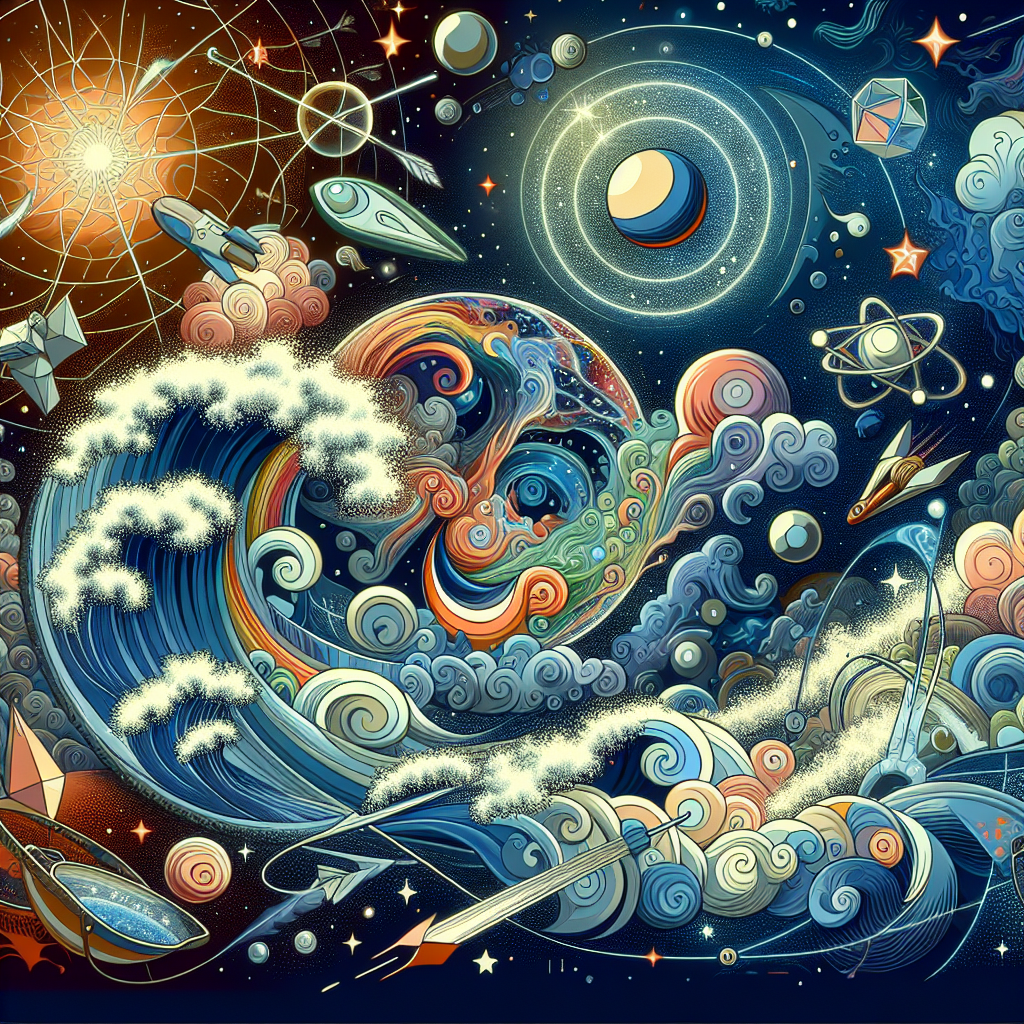
Imagine the vastness of space as a giant ocean, where instead of water, waves of energy ripple across the universe. These waves, known as gravitational waves, are created when massive objects like black holes or neutron stars collide or move in space. Albert Einstein first predicted these waves in his theory of relativity, but it wasn't until 2015 that scientists detected them directly. These waves help us understand the movements and secrets of objects billions of light-years away, acting like cosmic messengers from the farthest reaches of space.
Gravitational waves are incredibly tiny, and it takes special instruments to detect them. Scientists use observatories equipped with laser interferometers, which can measure changes in distance smaller than a fraction of a proton. This technology allows us to 'listen' to the universe in a completely new way, providing insights into events that would otherwise remain hidden from our telescopes. Through these discoveries, we gain a better understanding of the universe's history and the forces that shape it.
The study of gravitational waves is still in its early stages, and each new detection brings more questions and exciting possibilities. By learning how these waves move through space, scientists can uncover new phenomena, expanding our knowledge of how the universe works.
Gravitational waves are incredibly tiny, and it takes special instruments to detect them. Scientists use observatories equipped with laser interferometers, which can measure changes in distance smaller than a fraction of a proton. This technology allows us to 'listen' to the universe in a completely new way, providing insights into events that would otherwise remain hidden from our telescopes. Through these discoveries, we gain a better understanding of the universe's history and the forces that shape it.
The study of gravitational waves is still in its early stages, and each new detection brings more questions and exciting possibilities. By learning how these waves move through space, scientists can uncover new phenomena, expanding our knowledge of how the universe works.
Ask Your Kid: Ask Your Kid: What do you think it would be like to 'hear' the universe through gravitational waves, and what mysteries do you think they might reveal?