
Discovering Cosmic Colors
December 18, 2025
Listen to this lesson:
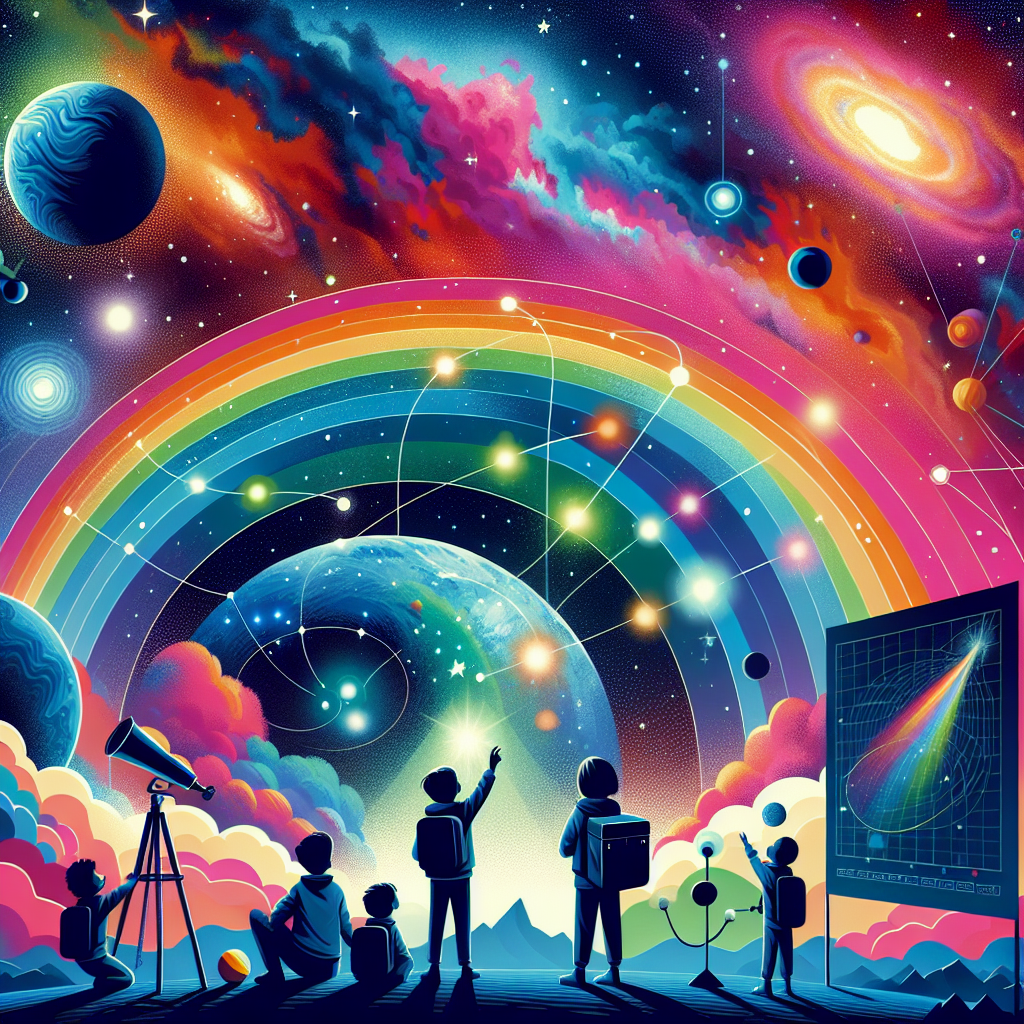
Welcome to the vibrant world of cosmic colors! Space isn't just black and white; it's filled with a spectrum of colors that tell stories about the universe. Stars, for example, come in different colors based on their temperatures. The coolest stars appear red, while the hottest shine blue-white. Imagine looking at the night sky with a special telescope that lets you see these celestial rainbows!
Planets also have distinct colors. Mars, known as the Red Planet, gets its rusty color from iron oxide, or rust, on its surface. Meanwhile, Neptune's deep blue hue is due to the presence of methane in its atmosphere. Exploring the colors of space can help us understand the composition and characteristics of celestial bodies, adding a splash of intrigue to our cosmic adventures.
The universe's colors aren't just pretty; they are clues. Astronomers use these colors to figure out what stars and planets are made of, how they are moving, and even how old they are. By studying the light from distant galaxies, scientists can piece together the history of the universe. Isn't it amazing how much we can learn just by looking at colors?
Planets also have distinct colors. Mars, known as the Red Planet, gets its rusty color from iron oxide, or rust, on its surface. Meanwhile, Neptune's deep blue hue is due to the presence of methane in its atmosphere. Exploring the colors of space can help us understand the composition and characteristics of celestial bodies, adding a splash of intrigue to our cosmic adventures.
The universe's colors aren't just pretty; they are clues. Astronomers use these colors to figure out what stars and planets are made of, how they are moving, and even how old they are. By studying the light from distant galaxies, scientists can piece together the history of the universe. Isn't it amazing how much we can learn just by looking at colors?
Ask Your Kid: Ask Your Kid: Why do you think colors are important for learning about space?