The Dance of Moons: Exploring Celestial Choreography
December 14, 2025
Listen to this lesson:
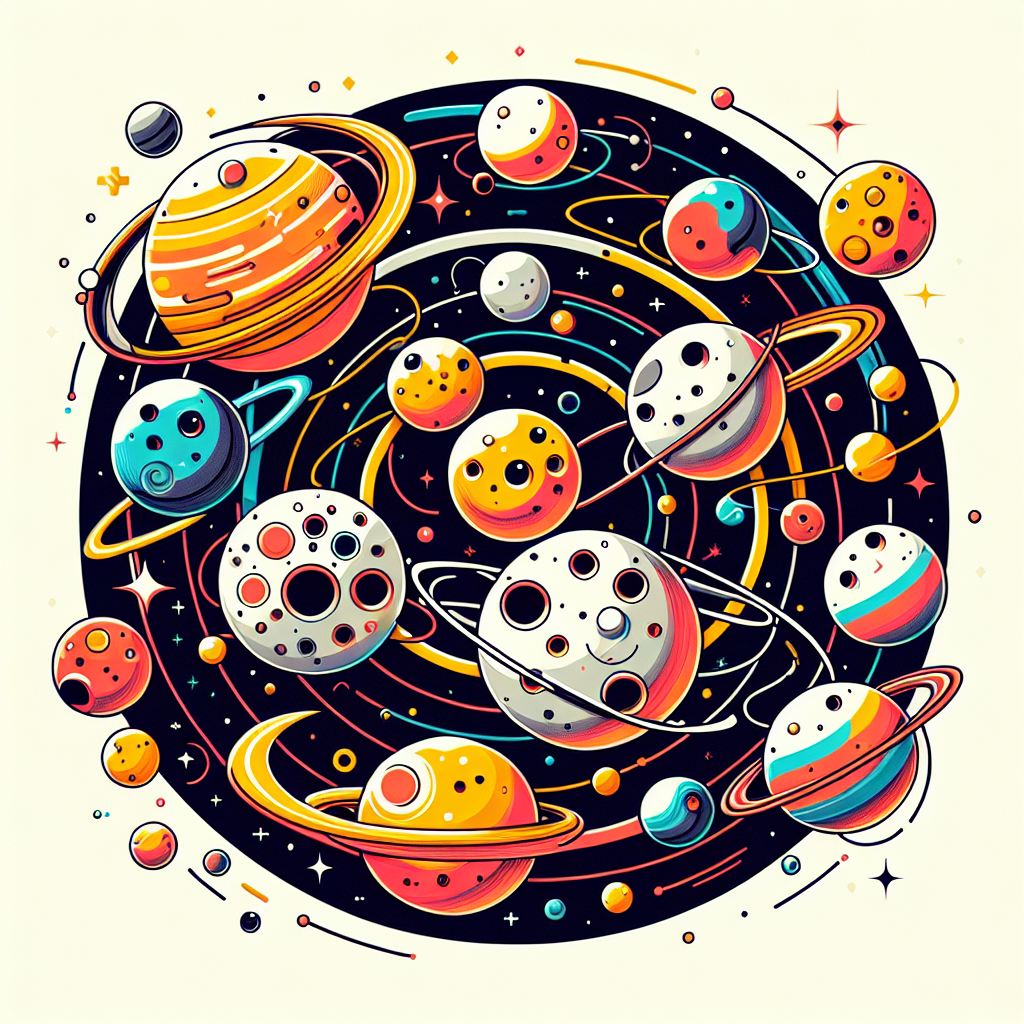
In the vast stage of our universe, moons play a fascinating role as they orbit their planets, each with its own unique path and rhythm. Consider Jupiter, the giant planet with a retinue of 79 known moons, each contributing to a cosmic ballet. One of its most famous moons, Io, is renowned for its volcanic activity, which is constantly reshaping its surface. Meanwhile, Europa, another of Jupiter's moons, intrigues scientists with the possibility of an ocean beneath its icy crust, hinting at the potential for life.
Further out, Saturn's moon Titan presents a mysterious world cloaked in thick orange clouds. Unlike any other moon, Titan boasts rivers and lakes of liquid methane, creating an alien landscape that challenges our understanding of life-sustaining environments. This diversity among moons invites us to wonder about their formation and evolution, and how they influence their parent planets. Some moons even have atmospheres and weather systems, offering a glimpse into the complexity of celestial bodies.
As we explore these distant worlds, moons teach us about the gravitational dance that keeps them tethered to their planets, affecting everything from tides to climates. This dance is orchestrated by the force of gravity, a powerful force that governs the movement of planets, moons, and even galaxies across the universe.
Further out, Saturn's moon Titan presents a mysterious world cloaked in thick orange clouds. Unlike any other moon, Titan boasts rivers and lakes of liquid methane, creating an alien landscape that challenges our understanding of life-sustaining environments. This diversity among moons invites us to wonder about their formation and evolution, and how they influence their parent planets. Some moons even have atmospheres and weather systems, offering a glimpse into the complexity of celestial bodies.
As we explore these distant worlds, moons teach us about the gravitational dance that keeps them tethered to their planets, affecting everything from tides to climates. This dance is orchestrated by the force of gravity, a powerful force that governs the movement of planets, moons, and even galaxies across the universe.
Ask Your Kid: Ask Your Kid: If you could visit any moon in our solar system, which one would you choose and what would you hope to discover there?