
Journey to the Moons of Jupiter
December 11, 2025
Listen to this lesson:
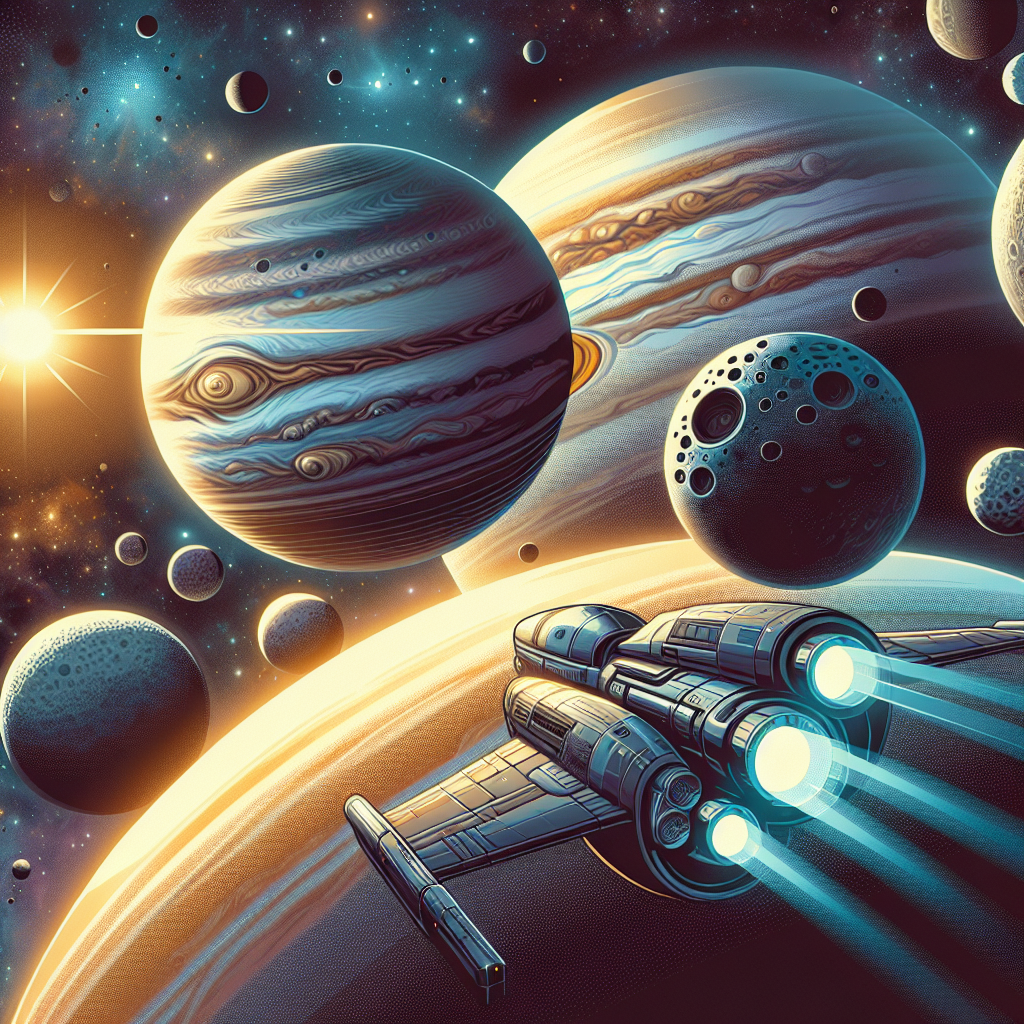
Let's embark on an exciting mission to explore the fascinating moons orbiting Jupiter! Jupiter has over 75 moons, each with its own unique characteristics. Among them, four large moons, known as the Galilean moons, stand out: Io, Europa, Ganymede, and Callisto. These moons were discovered by Galileo Galilei over 400 years ago and continue to captivate astronomers with their intriguing features. Io is the most volcanically active body in our solar system, with hundreds of volcanoes spewing lava and gas. Europa, on the other hand, is covered in a thick layer of ice, beneath which scientists believe an ocean of liquid water might exist. Ganymede, the largest moon in the solar system, even has its own magnetic field, while Callisto's heavily cratered surface hints at a long history of cosmic impacts.
Our journey doesn't stop there! Imagine what life might be like on these moons. Europa's potential ocean could harbor simple life forms, making it a prime candidate for future exploration. Scientists are keen on sending robotic missions to drill through Europa's icy crust to find signs of life. Meanwhile, Ganymede's magnetic field opens up exciting possibilities for studying how such phenomena occur outside of Earth. By understanding these distant worlds, we gain insights into the conditions that make a planet or moon habitable and learn more about the origins of life itself.
Exploring the moons of Jupiter not only excites the imagination but also challenges our understanding of the universe. These lunar bodies offer a window into the diverse environments that can exist within our solar system, prompting questions about the nature of life and our place in the cosmos. As we dream of future missions to these distant worlds, we are reminded of the endless possibilities that await our discovery.
Our journey doesn't stop there! Imagine what life might be like on these moons. Europa's potential ocean could harbor simple life forms, making it a prime candidate for future exploration. Scientists are keen on sending robotic missions to drill through Europa's icy crust to find signs of life. Meanwhile, Ganymede's magnetic field opens up exciting possibilities for studying how such phenomena occur outside of Earth. By understanding these distant worlds, we gain insights into the conditions that make a planet or moon habitable and learn more about the origins of life itself.
Exploring the moons of Jupiter not only excites the imagination but also challenges our understanding of the universe. These lunar bodies offer a window into the diverse environments that can exist within our solar system, prompting questions about the nature of life and our place in the cosmos. As we dream of future missions to these distant worlds, we are reminded of the endless possibilities that await our discovery.
Ask Your Kid: Ask Your Kid: If you could design a spacecraft to explore one of Jupiter's moons, which moon would you choose and what kind of experiments would you conduct there?